

VDS 1
1 vCPU
AMD EPYC
2 GB
DDR4 ECC RAM
25 GB
NVMe Storage
10 Gbit
Port · unlimited traffic
$7/mo
New: every layer redundant cloud servers, now in every plan, at no extra cost!


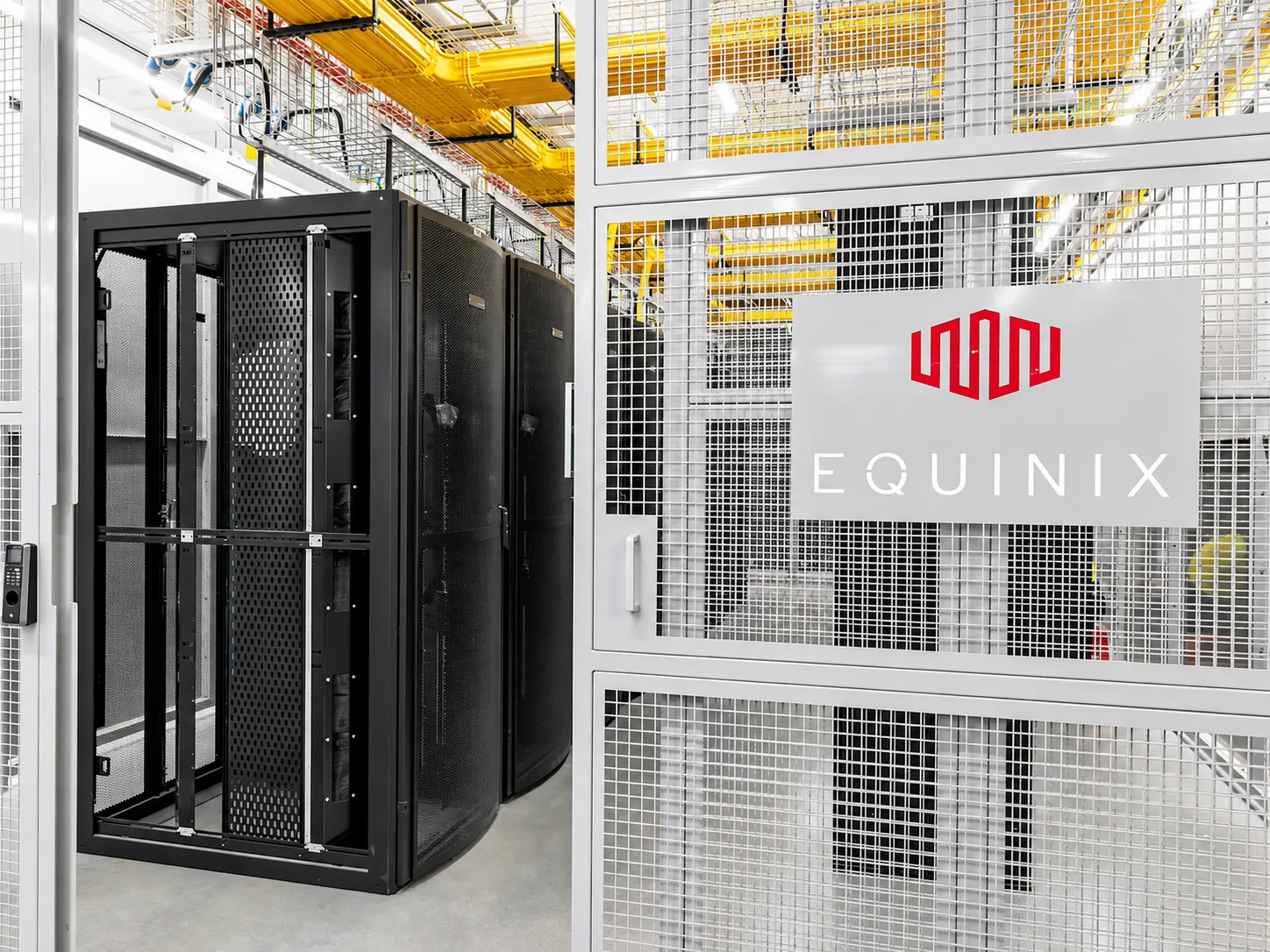
Our servers run in Equinix IL4 in Ümraniye, Istanbul, in our own racks. A carrier-neutral facility with direct paths to Turkey's major networks; measured latency published on this page.
From the smallest to the largest. Every plan runs on AMD EPYC processors and NVMe storage in Istanbul.
1 vCPU
AMD EPYC
2 GB
DDR4 ECC RAM
25 GB
NVMe Storage
10 Gbit
Port · unlimited traffic
$7/mo
Most Popular Plan
2 vCPU
AMD EPYC
4 GB
DDR4 ECC RAM
50 GB
NVMe Storage
10 Gbit
Port · unlimited traffic
$11/mo
2 vCPU
AMD EPYC
8 GB
DDR4 ECC RAM
80 GB
NVMe Storage
10 Gbit
Port · unlimited traffic
$17/mo
4 vCPU
AMD EPYC
8 GB
DDR4 ECC RAM
120 GB
NVMe Storage
10 Gbit
Port · unlimited traffic
$21/mo
4 vCPU
AMD EPYC
16 GB
DDR4 ECC RAM
160 GB
NVMe Storage
10 Gbit
Port · unlimited traffic
$30/mo
6 vCPU
AMD EPYC
24 GB
DDR4 ECC RAM
240 GB
NVMe Storage
10 Gbit
Port · unlimited traffic
$42/mo
8 vCPU
AMD EPYC
32 GB
DDR4 ECC RAM
320 GB
NVMe Storage
10 Gbit
Port · unlimited traffic
$55/mo
12 vCPU
AMD EPYC
48 GB
DDR4 ECC RAM
480 GB
NVMe Storage
10 Gbit
Port · unlimited traffic
$80/mo

Equinix facilities connect to many carriers; your traffic reaches Türk Telekom, Vodafone, Turkcell and international transit over short paths.

HPE and Dell servers, Arista and Juniper switches, owned and operated by CloudBT. We are not reselling another provider's VPS.

Latency from the facility, measured on October 5, 2026: 1.4 ms to Cloudflare Istanbul, 1.8 ms to Türk Telekom, 3.1 ms to Borsa Istanbul.
IL4 is part of Equinix's Istanbul campus. The figures below are from Equinix's public announcements and our own measurements.

Location: Dudullu Organized Industrial Zone, Ümraniye, Istanbul (Asian side).
Capacity: Equinix announced IL4 in October 2024 with about 1,125 cabinets over roughly 3,044 square meters of colocation space, as part of a campus of more than 7,500 square meters.
Cooling and power: Designed for high-density and liquid-cooling-ready deployments; redundant power paths.
Connectivity: Carrier-neutral with access to Turkish operators and international carriers; Equinix has operated in Turkey since 2017.
| Destination | Measured latency | Method |
|---|---|---|
| Cloudflare Istanbul | 1.4 ms | ICMP |
| TurkNet (ISP) | 1.7 ms | TCP connect |
| Türk Telekom (DNS server) | 1.8 ms | ICMP |
| Borsa Istanbul (stock exchange) | 3.1 ms | TCP connect |
| Vodafone Turkey | 6.2 ms | TCP connect |
| Google Public DNS | 10.2 ms | ICMP |
| e-Devlet (government portal) | 10.8 ms | TCP connect |
| Turkcell | 14.2 ms | TCP connect |
Measured on October 5, 2026. Measured from our production server in Equinix IL4, Istanbul. ICMP values are the average of ten packets; TCP values are the connection setup time to port 443 (DNS resolution excluded, lowest of six attempts). Values vary with network conditions.
| From Istanbul to | Measured latency |
|---|---|
| Milan | 30 ms |
| Frankfurt | 35 to 45 ms |
| Nuremberg and Falkenstein | 37 to 40 ms |
| Amsterdam | 40 to 51 ms |
| Warsaw | 45 ms |
| London | 47 to 52 ms |
| Paris | 47 to 56 ms |
| Stockholm and Helsinki | 56 ms |
| US East Coast | 117 to 130 ms |
| Singapore | 188 to 190 ms |
Comparison values were measured from the same server to the test servers of public cloud providers in each city. A visitor in Turkey reaching a server in that city travels roughly the same path.
Two providers with the same CPU and the same disk can differ by tens of milliseconds for the same visitor, simply because of where the rack stands and which carriers the facility connects to. For a Turkish audience, Istanbul beats every Western European location; inside Istanbul, a carrier-neutral facility beats a single-carrier one.
Hardware, network design and the measurement commands: Infrastructure

Ümraniye, inside Equinix's Istanbul campus.

Dual power supplies per server, two 100G uplinks per host to separate switches.
Each customer in its own VLAN; VXLAN private networks for virtual data centers.

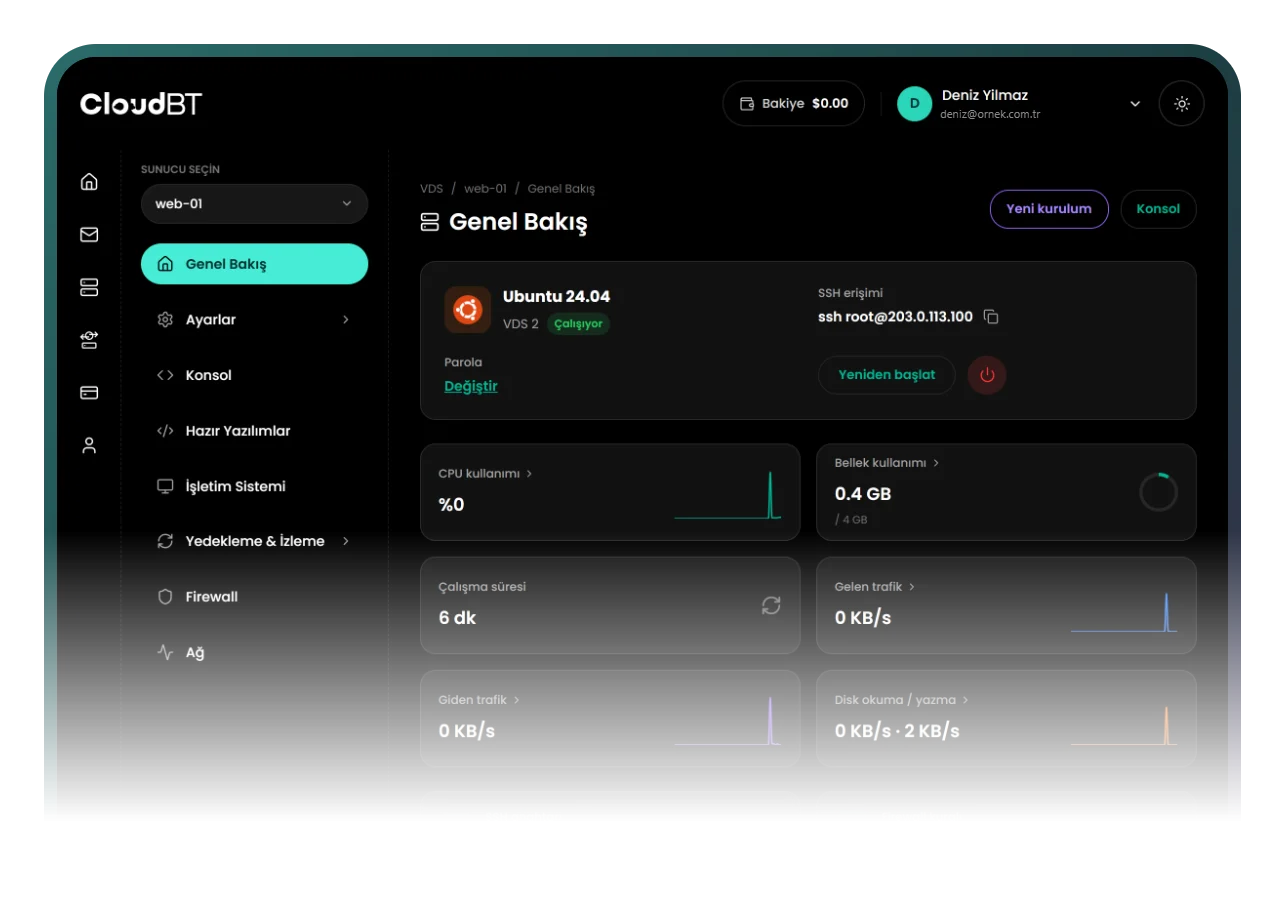
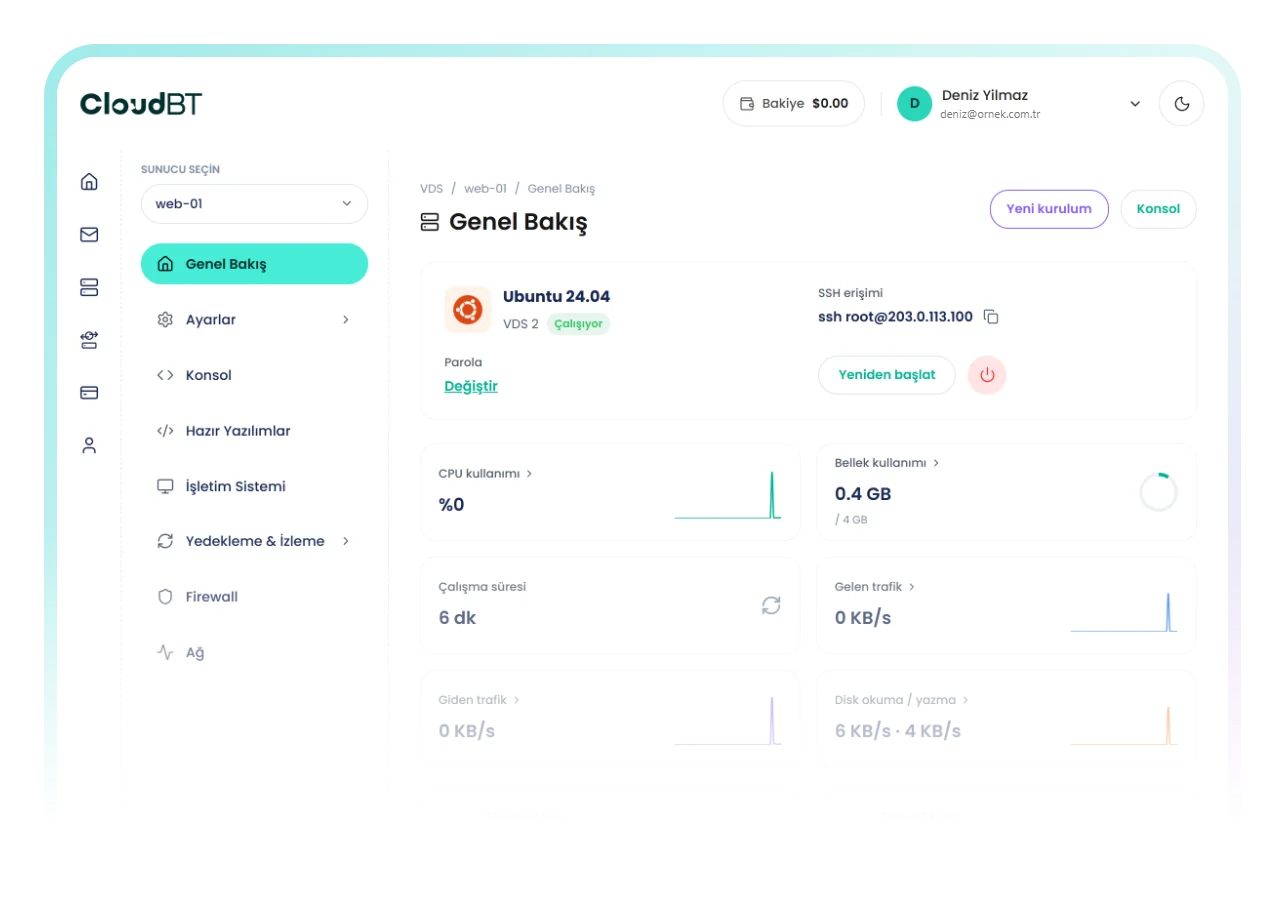
Automatic provisioning; SSH or RDP details in the panel.
Every plan, from the smallest VPS to a virtual data center, runs on the same hardware in this facility.
Dual AMD EPYC processors in every physical host. Your virtual server runs on cores reserved for you.

The entire storage layer is NVMe SSD. Database queries and file operations are noticeably faster than on SATA SSD.
Every host connects to two separate switches with a 100G link each. If a switch or link fails, your traffic flows over the other.
Three snapshots per server and a panel-managed firewall are included in every plan.

Dual power supplies, ECC memory and hot-swap drives as standard.
Low-latency switching with redundant uplinks at the core and access layers.
ICMP, average of ten packets.
Equinix operates interconnection-focused data centers worldwide; its Istanbul campus is where Turkish operators, international carriers and cloud on-ramps meet. Hosting in IL4 means our servers sit next to the networks our customers' users are on, which is what the measurements on this page show.

Questions about hosting in Equinix Istanbul.
No. CloudBT is an independent Turkish hosting company that colocates its own hardware in Equinix IL4. Equinix provides the facility, power and interconnection; CloudBT provides the servers, network and service.
Not through CloudBT; we sell virtual servers and virtual data centers on our hardware. For colocation contact Equinix directly.
Data center visits are arranged case by case for enterprise customers; contact us.
Yes. Open a ticket from the panel in English or Turkish, around the clock. Server and network issues are handled by the engineers who run the platform.
Deployment is automatic. A Linux server is usually ready within a few minutes of payment confirmation; connection details appear in the panel and in your email.
By bank transfer (SWIFT or SEPA to our Turkish bank account). Card payments are being added. Your server is deployed automatically once the payment is confirmed.
Console, snapshots, firewall, reinstall and resource graphs; also through the API and MCP.